Model weights, SGLang inference code, and SpecForge training code are open source.
In DMTP V1, we discussed three sources of improvement over DFlash: MTP's first-token capability, shifting parallel drafting after a known T1, and the extra information in MTP hidden states.
V1.5 separates these effects, focusing on the gain from shifting the draft, which can be obscured by a stronger first token.
Even with similar first-token accuracy, DMTP can benefit: MTP proposes T1, so DFlash starts at T2 and predicts continuation tokens one position closer to its known prefix.
1. Three Sources of Improvement
First-token pretraining: training and domain matter
MTP does not inherently have higher first-token accuracy than DFlash. The comparison depends on training, data distribution and evaluation domain. A task-trained DFlash can match or outperform MTP in familiar settings.
In our tested Qwen3.5 and Qwen3.6 configurations, MTP had a clear first-token advantage. In our tested Qwen3.8 configuration, DFlash2 approaches MTP's first-token accuracy.
We suspect target training-data patterns contribute to this change. Results also vary across teams; we have observed stronger MTP first-token performance in GLM settings.
The point is not that MTP must always win. Its first-token predictor has seen extensive pretraining data and may retain stronger out-of-distribution generalization.
DMTP reuses this capability through T1, then continues with parallel DFlash drafting. This motivates extending it to longer and more complex workloads, rather than guaranteeing gains in every domain.
Shifting: DMTP's second token is DFlash's first unknown token
Original DFlash predicts T1, T2, T3 and so on from A. DMTP first obtains T1, then asks DFlash for T2 onward. Training uses ground-truth T1; inference uses the actual MTP proposal.
Original DFlash: A known      -> predict T1, T2, T3 ...
DMTP:           A, T1 known  -> predict T2, T3, T4 ...
                                       ^
                              first unknown position
DMTP's T2 therefore takes the role of DFlash's first unknown token. Its training accuracy can approach the original draft's T1 accuracy, rather than facing the original second-position task. Later positions can benefit similarly.
This changes the conditioning of parallel drafting, not just token indices. Gains still depend on training, T1 quality and inference distribution; the shift alone does not guarantee higher accuracy at every position.
With similar first-token accuracy, replacing T1 alone has less room to help. Shifting remains an important source of acceptance-length improvement, and is the focus of V1.5.
Hidden information: passing the representation that predicted T1
MTP provides both a discrete T1 and the hidden state that predicted it. That representation gives DFlash extra information, separate from first-token accuracy and the known-T1 shift.
Our earlier comparisons found modest gains from hidden information, with relatively small differences between injection methods. We retain a residual interface to preserve the embedding path during continued fine-tuning.
2. Ablations: First Token, Hidden State and Shift
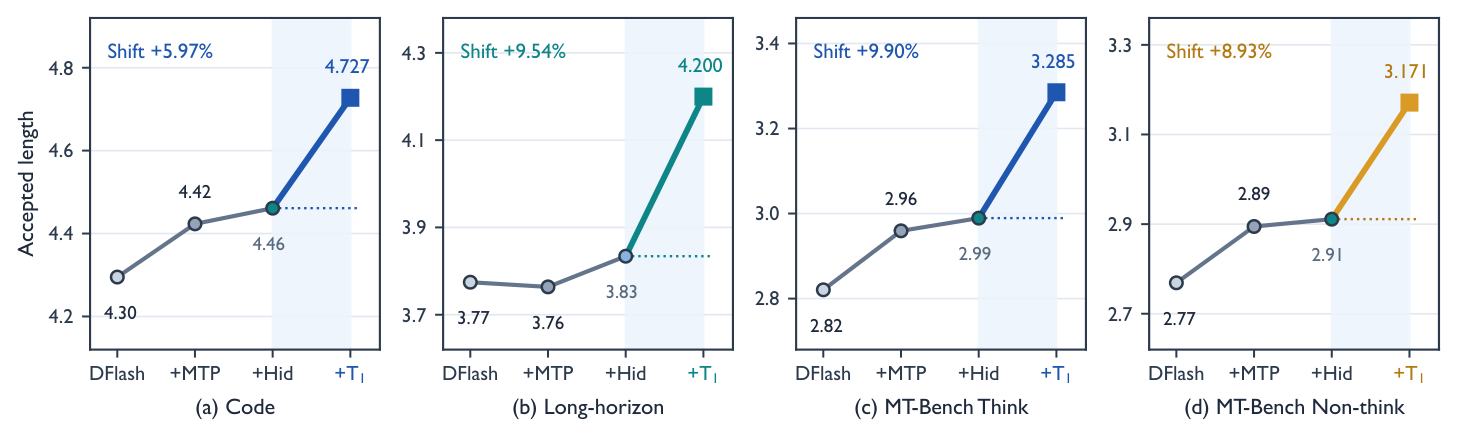
On Qwen3.7-Turbo, we progressively replace DFlash's first candidate with MTP T1 (+ MTP first token), add MTP hidden information (hidden-only), then condition drafting on a known T1 to predict T2 onward (hidden + T1).
Figure 1. Per-verify mean acceptance length as we add MTP T1, MTP hidden information and known-T1 conditioning. Both trained variants use 60K checkpoints.
Dataset
First-token increment
Hidden increment
T1 / shift increment
Shift vs. hidden-only
Code
+0.1283
+0.0378
+0.2662
+5.97%
Long-horizon
−0.0107
+0.0703
+0.3657
+9.54%
MT-Bench Think
+0.1387
+0.0299
+0.2960
+9.90%
MT-Bench Non-think
+0.1257
+0.0163
+0.2600
+8.93%
Increments compare adjacent variants; percentages use hidden-only as the denominator. These are per-verify acceptance lengths, not end-to-end throughput.
Here, MTP's first-token accuracy is only 1–2 percentage points higher. Substitution and hidden information give smaller gains, while shifting adds 5.97%–9.90% across all four workloads.
With similar first-token accuracy, moving DFlash's continuation back to its first unknown position is an important source of DMTP's gains.
3. From scratch and From ckpt
We tried both training from scratch and continuing from a checkpoint. Continuation offers a faster path to reusing an existing Draft.
From scratch
For Qwen3.6-27B, we freeze the Target and native MTP and train the DMTP Draft from scratch. Weights are available at Piggy12/Qwen3.6-27B-DMTP.
The baseline is DFlash2 with the same training configuration. Both drafters train for three epochs on regenerated OpenPerfectBlend with a 3K training sequence limit and no Agent data. Evaluation enables thinking and exact RS, at temperature 1.0 with 128K input and 64K output limits. Accepted length is per-verify, including correction/bonus; Native MTP is the four-step reference.
Dataset
Native MTP
DFlash2
DMTP
Code
3.5697
3.9621
4.6022
Math
3.6913
4.2909
4.8871
MT-Bench
3.1467
4.0044
4.1826
Agent
4.1280
3.8197
4.6871
SWE
3.2583
2.9273
3.9427
Long-horizon
3.7297
3.1929
4.3310
General
3.2227
3.3412
3.7736
Reason
3.5974
4.1282
4.7106
Search
3.1624
3.4653
4.0437
The training data contains no Agent data, yet DMTP improves acceptance on Agent, SWE and Long-horizon. This supports reusing MTP's pretrained capabilities to strengthen DFlash2 drafting without additional Agent-specific training.
These gains measure acceptance length, not task success rates.
Short-context evaluation uses a 4K input limit, 1,024 output tokens, temperature 1.0, TP4, batch size 32, and natural EOS; MT-Bench uses two turns. Under the same regenerated-OPB setup:
Dataset
Native MTP
DFlash2
DMTP
GSM8K
3.9737
5.8619
5.9383
MATH500
3.9968
5.7963
5.9702
HumanEval
3.6617
5.1567
5.3305
MT-Bench
3.2994
4.4048
4.4654
Alpaca
3.2405
4.2018
4.3257
Short-context math and code are closer to the training data, so DFlash2 is already strong and the margin is smaller. On Agent, SWE, and Long-horizon, which are absent from draft training, reusing pretrained MTP yields wider generalization gains.
From ckpt
We fine-tune an existing DFlash2 checkpoint on SFT data, adding two anchors and a zero-initialized T1 residual. Target and MTP remain frozen; only the Draft, selector and residual layer are updated.
A few thousand fine-tuning steps suffice to learn DMTP's known-T1 continuation from T2 onward, without retraining the entire Draft.
On Qwen3.8-Next, DMTP and DFlash2 start from existing checkpoints and use the same SFT data and fine-tuning budget. Evaluation uses 128K input and 64K output limits, temperature 1.0, exact RS, and batch size 32. We report per-verify accepted length below, followed by first-token acceptance on six long-context workloads.
Dataset
Native MTP
DFlash2
DMTP
Code
3.0136
2.8793
3.2858
Math
3.0916
2.9534
3.3600
MT-Bench
2.9210
2.8380
2.9879
Agent
3.7712
3.8963
4.2819
SWE
3.7817
4.0989
4.4628
Long-horizon
3.5106
3.5280
4.0195
General
2.8158
2.5339
2.7944
Reason
2.9740
2.7902
3.2578
Search
3.2090
2.9158
3.1454
Dataset
DFlash2 first token
DMTP first token
General
61.80%
67.40%
Reason
69.46%
77.04%
Agent
76.82%
82.10%
Long-horizon
74.03%
81.43%
SWE
81.96%
86.86%
Search
63.23%
67.62%
A separate K=8 experiment starts from a CPT (Continued Pre-training) DFlash2 checkpoint. DMTP and the DFlash2 baseline use matched fine-tuning budgets on the same 128K SFT data; DMTP is reported at 4,000 steps. Its first-token acceptance already approaches or exceeds MTP on several tasks, yet shifting still improves continuation.
Each cell lists MTP / DFlash2 CPT / DMTP4000, with DMTP in bold. Values are per-verify cumulative acceptance rates (%, excluding bonus), not conditional acceptance rates.
Dataset
T1
T2
T3
T4
General
74.78 / 75.69 / 75.15
55.27 / 54.31 / 57.90
41.38 / 39.28 / 43.99
31.72 / 29.14 / 34.07
Reason
75.72 / 75.91 / 76.04
56.45 / 52.58 / 58.73
42.00 / 35.74 / 43.00
31.50 / 24.60 / 30.93
Agent
86.40 / 86.58 / 85.87
74.73 / 73.56 / 75.17
65.12 / 63.10 / 65.61
57.18 / 55.19 / 57.75
Long-horizon
83.13 / 83.08 / 82.87
70.00 / 66.99 / 71.35
59.28 / 54.66 / 60.92
50.99 / 45.35 / 51.96
SWE
86.63 / 88.08 / 86.51
74.61 / 74.54 / 76.54
64.64 / 62.72 / 66.35
56.03 / 53.24 / 57.43
Search
80.30 / 82.83 / 79.81
62.97 / 64.08 / 64.93
49.32 / 48.40 / 50.41
38.90 / 36.71 / 38.55
Dataset
T5
T6
T7
T8
General
24.86 / 22.36 / 27.16
19.61 / 17.65 / 21.99
15.53 / 14.21 / 18.05
12.22 / 11.68 / 14.88
Reason
23.75 / 17.39 / 22.35
18.00 / 12.65 / 16.36
13.74 / 9.43 / 12.20
10.53 / 7.21 / 9.26
Agent
50.52 / 48.88 / 51.42
44.53 / 43.91 / 46.21
39.39 / 39.73 / 41.97
34.58 / 36.21 / 38.31
Long-horizon
44.08 / 38.24 / 44.69
38.03 / 32.81 / 39.03
33.00 / 28.70 / 34.55
28.76 / 25.29 / 30.72
SWE
49.13 / 45.93 / 49.85
43.12 / 40.39 / 44.03
37.71 / 35.98 / 39.37
32.85 / 32.56 / 35.53
Search
30.69 / 28.27 / 29.67
24.50 / 22.17 / 23.36
19.57 / 17.76 / 18.80
15.57 / 14.45 / 15.25
From T2 onward, DMTP exceeds DFlash2 CPT at every reported position on all six workloads, and exceeds MTP at most positions. This illustrates the benefit of shifted, known-T1 continuation even when first-token performance is similar.
Sparse RS
The inference pipeline now supports sparse RS: only top-k logits are stored for every candidate token, including T1, reducing transfer overhead in TP (Tensor Parallelism) communication. We also plan to integrate and test sparse Block Verify.
4. Joint Training: Strengthening the First Token on Specialized Tasks
A frozen MTP can limit DMTP when its first-token accuracy trails a domain-trained DFlash. We therefore explore joint MTP–DFlash SFT: preserve the shifted continuation task while adapting MTP's first-token prediction to specialized data.
We keep the Target backbone frozen and train MTP's first-token prediction alongside DFlash's continuation, allowing both to adapt to specialized data.
Joint Loss: Learning the First Token and Continuation
MTP predicts T1; the DFlash base head predicts T2–T8. Both match the frozen Target's full-vocabulary distribution with LogTV. The selector additionally uses teacher-to-selector KL within each position's top-16 candidate set.
At inference, continuation candidates are sampled from the conditional selector distribution using predecessor-token information, not directly from the base-head distribution used in LogTV.
Here p is the Target distribution, q the corresponding MTP or DFlash base-head distribution, and s the selector distribution. Both KL distributions are renormalized within candidate set S.
LogTV weights decay across all eight positions. The selector retains its seven-position weighting; no T1 selector loss or extra hard-label CE is added.
T1 LogTV updates MTP; tail objectives update DFlash, the selector and fusion layer. The MTP hidden passed to fusion remains detached, so tail gradients do not reach MTP. The Target backbone, shared embedding and LM head remain frozen.
The formula describes one valid block. The implementation aggregates with loss masks and retains existing MoE auxiliary objectives.
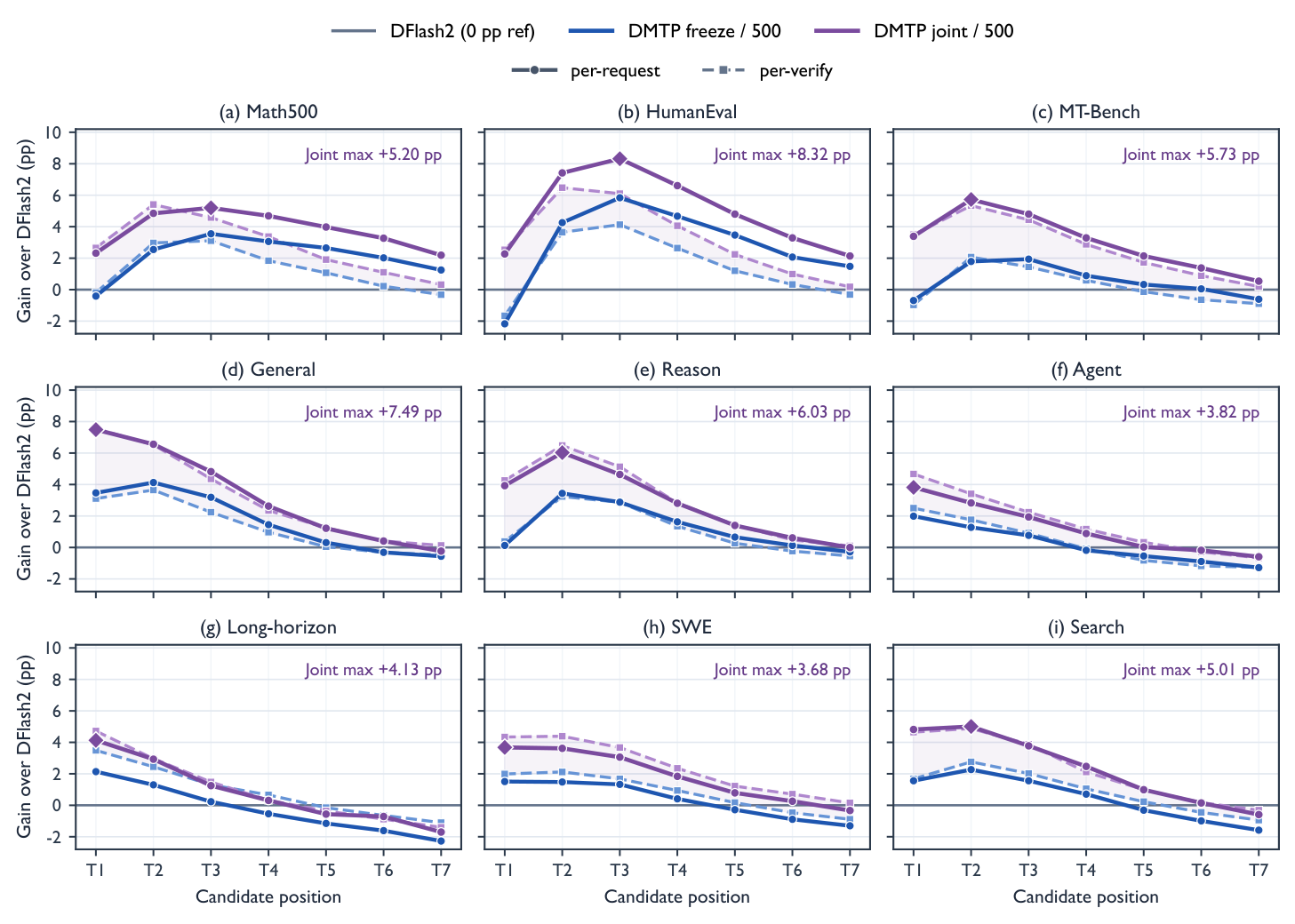
Figure 2. Cumulative acceptance gains over DFlash V2 (pp). Blue: frozen MTP; purple: joint training. We focus on the per-verify dashed lines; solid lines show per-request statistics.
Joint training can restore a first-token advantage. On Math500, HumanEval and MT-Bench, frozen-MTP T1 trails DFlash V2 slightly. After joint training, the per-verify T1 gain turns positive, with larger gains at several later positions too.
Terminal Bench: Adapting with RL Traces
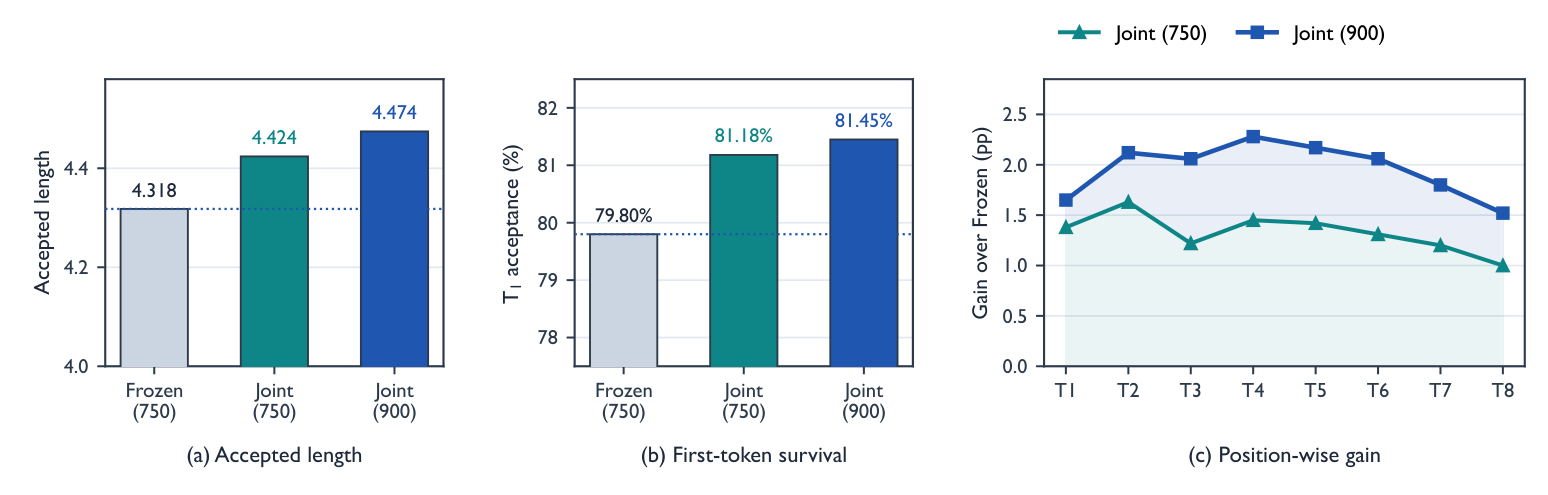
Figure 3. At a matched training budget, joint training improves first-token acceptance, accepted length, and cumulative acceptance across the block.
We also perform SFT on collected Terminal Bench RL traces for terminal and agent workloads, rather than online RL. This separate comparison starts from the same CPT initialization and keeps the Target backbone unchanged.
We compare Draft-only training with frozen MTP against joint MTP–Draft training. Evaluation uses 255 expanded Terminal Bench requests, rejection sampling, concurrency 32 and eight draft candidates per round.
All metrics below are per-verify. Acceptance length includes the bonus token; first-token acceptance excludes it. Length gains are relative to the frozen-MTP baseline.
Training
Acceptance length
First-token acceptance
Length gain
Draft-only, frozen MTP / 750 steps
4.3178
79.80%
—
Joint / 750 steps
4.4239
81.18%
+2.46%
Joint / 900 steps
4.4745
81.45%
+3.63%
At the same 750 steps, joint training adds 1.38 percentage points of first-token acceptance and 2.46% acceptance length. The 900-step result also includes 150 additional training steps relative to the baseline.
These are inference acceptance statistics, not Terminal Bench task success rates.
Shifting strengthens continuation; joint training strengthens the specialized first token. Together, they give DMTP more pronounced acceptance gains on these specialized workloads.
5. Future Directions
First-token Prediction Without Native MTP Pretraining
Future target models may not include an MTP module trained during pretraining. We are exploring EAGLE + DFlash: a lightweight EAGLE-style predictor supplies the first token, followed by parallel DFlash continuation.
Joint CPT of the first-token module and DFlash could reduce dependence on native pretrained MTP. The goal is a lower additional training budget, without repeating target-scale pretraining.
This may offer a next-generation speculative-decoding paradigm, but its effectiveness, generalization and training cost remain research questions. Key directions include:
Explaining the first-token gap. How much comes from depth, architecture, hidden-state injection, data and training objectives?
Reducing serial cost. How can LM-head projection, token selection and first-token execution become cheaper while preserving sampling correctness?
Designing joint losses. How should first-token, tail, selector and positional objectives be balanced to retain generalization and better align training with acceptance length and throughput?
Building with the Community
We are collaborating with multiple teams to bring DMTP into practice.
Weights and inference code are open source. Architecture, joint training and inference optimization all benefit from shared community maintenance. We welcome reproductions, feedback and contributions across models and workloads.